
Introduction
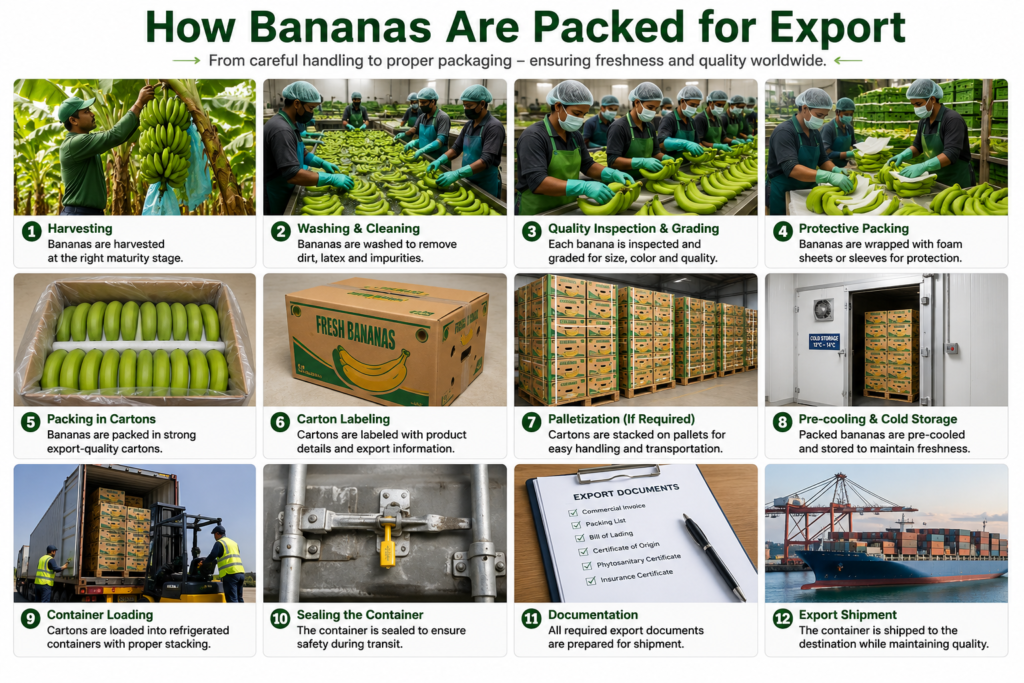
How bananas are packed for export is one of the most important factors in ensuring fresh, high-quality fruit reaches international markets. Proper harvesting, grading, packaging, and cold chain management help maintain freshness throughout transportation.
India is one of the leading banana exporters, supplying premium-quality bananas to countries across the world. At VM EXIM International, we follow international export standards to ensure every shipment is packed safely and delivered in excellent condition.
Why How Bananas Are Packed for Export Matters
Proper export packing helps:
- Protect bananas from bruising and damage
- Maintain freshness during transit
- Reduce post-harvest losses
- Improve shelf life
- Meet international import standards
- Ensure customer satisfaction
Poor packing can result in damaged fruit, faster ripening, and financial losses.
Step 1: Harvesting at the Right Stage
Bananas intended for export are harvested at the proper maturity level—not fully ripe.
During harvesting, exporters ensure:
- Correct maturity
- Uniform fruit size
- Healthy bunches
- No pest damage
- No physical injuries
Proper harvesting ensures better quality throughout the export journey.
Step 2: De-handing and Cleaning
After harvesting, banana bunches are separated into smaller clusters called hands.
The bananas are then washed to remove:
- Dirt
- Latex stains
- Dust
- Field residues
- Surface impurities
Cleaning improves appearance and hygiene.
Step 3: Quality Inspection and Grading
Every banana hand is inspected based on international quality standards.
Inspection includes:
- Fruit size
- Color
- Shape
- Weight
- Freedom from defects
- No bruises or cuts
Only export-quality bananas proceed to packing.
Step 4: Sorting and Grading
Bananas are sorted into different grades according to:
- Size
- Weight
- Length
- Uniformity
- Buyer specifications
Uniform grading improves presentation and buyer satisfaction.
Step 5: Protective Packing
Each banana hand is carefully protected before packing using:
- Foam sheets
- Protective sleeves
- Poly liners
- Soft cushioning materials
These materials reduce bruising during transportation.
Step 6: Packing into Export Cartons
Bananas are packed into strong export-quality corrugated cartons.
Each carton is designed to provide:
- Proper ventilation
- Moisture resistance
- High stacking strength
- Protection during shipping
The cartons are packed carefully to prevent movement inside the box.
Step 7: Carton Labeling
Every export carton is labeled with important information such as:
- Product Name
- Variety
- Country of Origin
- Net Weight
- Packing Date
- Batch Number
- Exporter Details
Proper labeling ensures traceability and compliance with international regulations.
Step 8: Palletization (If Required)
Depending on buyer requirements, cartons may be stacked on wooden or plastic pallets.
Proper palletization helps:
- Easy handling
- Stable transportation
- Faster container loading
- Reduced carton damage
Pallets are generally used only when required by the buyer or destination country.
Step 9: Pre-Cooling and Cold Storage
Before shipment, packed bananas are pre-cooled to remove field heat.
The cartons are then stored in temperature-controlled cold rooms to:
- Slow ripening
- Maintain freshness
- Preserve quality
- Extend shelf life
Maintaining the cold chain is essential for successful banana exports.
Step 10: Container Loading in How Bananas Are Packed for Export
The cartons are loaded carefully into refrigerated (reefer) containers.
During loading, exporters ensure:
- Proper air circulation
- Balanced weight distribution
- Correct stacking pattern
- Temperature maintenance
- Minimal carton movement during transit
Proper loading helps maintain fruit quality throughout the voyage.
Step 11: Documentation
The exporter prepares all required shipping documents, including:
- Commercial Invoice
- Packing List
- Bill of Lading
- Certificate of Origin
- Phytosanitary Certificate (if required)
- Insurance Certificate (for insured shipments)
- Other documents requested by the buyer
Accurate documentation ensures smooth customs clearance.
Step 12: Export Shipment
After customs clearance, the refrigerated container is loaded onto the vessel and shipped to the destination country while maintaining the required temperature throughout transit.
Best Practices for How Bananas Are Packed for Export
To maintain export quality:
- Harvest bananas at the correct maturity stage
- Handle fruit carefully to avoid bruising
- Use export-grade packaging materials
- Maintain proper hygiene during packing
- Ensure uniform grading
- Follow the cold chain throughout transportation
- Use quality cartons with proper ventilation
- Prepare accurate export documentation
Why Choose VM EXIM International?
At VM EXIM International, we are committed to delivering premium-quality bananas that meet international export standards.
We offer:
- Premium-quality export bananas
- Careful grading and packing
- International-standard packaging
- Cold chain management
- Reliable export documentation
- Timely global shipments
- Dedicated customer support
Conclusion
Proper banana packing is essential for maintaining freshness, reducing transit damage, and ensuring customer satisfaction in international markets. Every step—from harvesting and grading to protective packing, cold storage, container loading, and documentation—plays an important role in delivering high-quality bananas worldwide.
By following international best practices and working with experienced exporters like VM EXIM International, buyers can be confident of receiving fresh, premium-quality bananas that meet global export standards.